Amelia Chan

violinist | Creator, First Principles Violin

Amelia Chan is currently concertmaster of the City Chamber Orchestra of Hong Kong (CCOHK).

She came to this position from her tenure as concertmaster of the West Virginia Symphony Orchestra (US). An experienced leader, Amelia has served in the concertmaster chair under acclaimed conductors such as Sir Neville Marriner, Michael Tilson Thomas, Manfred Huss, Sergiu Commissiona, Anton Coppola, Zdeněk Mácal, Jorge Mester, Julius Rudel, and Gerard Schwarz. She has also performed with the New York Philharmonic extensively. As a chamber musician, Amelia has served as first violinist of the Montclaire String Quartet, and has collaborated with guitarist Sharon Isbin, accordionist Richard Galliano, violinist Lara St. John, the Ying Quartet, members of the Vienna Philharmonic Orchestra, and the Jupiter Symphony Chamber Players (NYC), among others. She has appeared as soloist with orchestras including the West Virginia Symphony, the International Virtuosi Orchestra on tour in Central America, the New Amsterdam Symphony Orchestra (NYC), the Brooklyn Symphony Orchestra (NYC), and the City Chamber Orchestra of Hong Kong. She has shared the stage as co-soloist with acclaimed flutist Sir James Galway, and frequently acts as director for the City Chamber Orchestra. She has performed at the Costa Rica Music Festival, the Guatemala Music Festival, Cooperstown Chamber Music Festival in New York and the Pacific Music Festival (Japan).

Amelia has been heard on WQXR, New York; WQED, Pittsburgh; West Virginia Public Broadcasting; BBC Radio Scotland, Scotland; and RTHK Radio 4, Hong Kong.

As an educator, Amelia approaches the teaching of technique through the lens of whole-body biomechanics, and on the principle that techniques of playing an instrument need to be relational to the body, and to how it moves, instead of relying on a static one-size-fits-all method. She believes in a focused and deep education that goes beyond rote training, where the student learns discernment and critical thinking, while sifting through the layers of intellect needed to decipher the depths of the musical art, to get to the natural, joyful simplicity of music-making.

Amelia holds undergraduate, graduate, and post-graduate degrees from the Mannes College of Music and Manhattan School of Music (NY). She began her violin studies in the junior school at the Hong Kong Academy for Performing Arts. Her major teachers included Thomas Wang, Alice Waten, Albert Markov, Shirley Givens, Lisa Kim, Yoko Takebe, Sheryl Staples, Glenn Dicterow, and double-bassist Julius Levine.

For more information on Amelia, please go to her Instagram page at https://www.instagram.com/ameliachanviolin/ 

——————————————————————————-

"Concertmaster Amelia Chan in particular played with passion, acting as the vibrant soul of the ensemble.” South China Morning Post 

“…gutsy solo violin throughout [by] concertmaster Amelia Chan…” theprickle.org

[Video] How to Reset the Left Shoulder for a Cleaner Technique

In this video, I share a resistance-band stretch that has been highly effective for myself and my students to address the elemental setup and reset of the left shoulder for violinists. This exercise physically expands your left arm's range of motion for maximum stability and technical execution. This is especially useful for high positions, double-stops, or any playing context where it feels like your left hand cannot reach far enough. And for professionals with chronic tension.

https://youtu.be/UQyHcaVnN3g

[Video] Stop Rushing: How to Master Controlled Momentum in Music

Rushing isn’t just about losing the tempo—it’s about losing “controlled momentum.”

Only playing problematic passages along with the metronome is often not enough. True stability comes from mastering the physics of sound and motion between the beats—balancing momentum and resistance.

In this video, I share two practical, tactile exercises using your own body and resistance bands to provide physical feedback for steady subdivisions and precise accelerandos.https://www.youtube.com/shorts/MemLKsHPT-w

[Video] The First Finger MCP Joint “X”: Engine of the Hand, Rudder of the Arm

I often emphasize how the body's larger, proximal structures must support the smaller, distal ones. However, focusing on a distal point can also serve as an effective entry point into efficient playing biomechanics, provided we treat the body as an integrated system rather than forcing the fingers and arms into unnatural positions in isolation.

This article explores that alternative pathway: how focusing on a single distal point—the metacarpophalangeal (MCP) joint of the index finger—can act as a sensory anchor that helps the nervous system self-organize for more efficient technique.

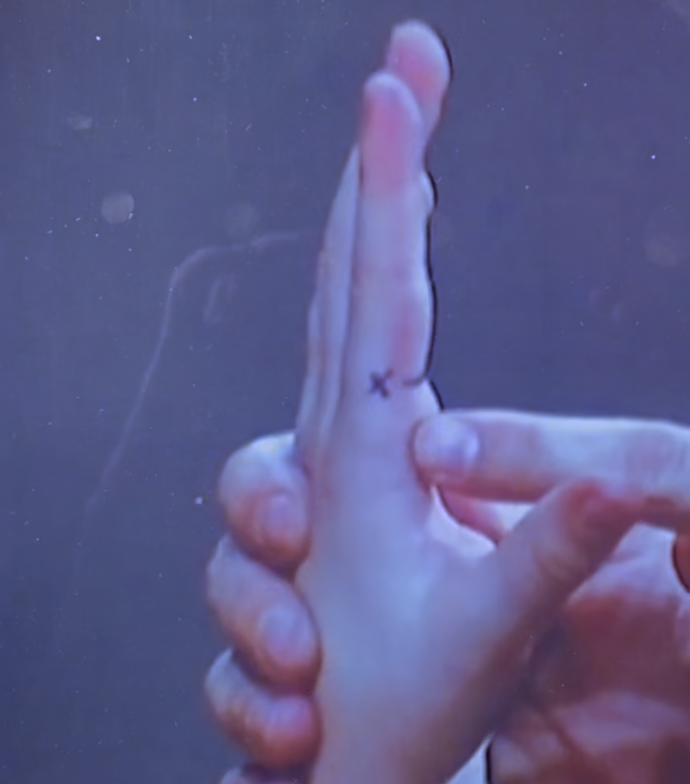
Paul Rolland teaches a wonderful setup in which he marks a line at the crease at the base of the first finger, alongside an “X” right beside that line. He instructs students to keep this line visible and the “X” near the violin neck. For children, this serves as an effective, simple visual guide to monitor and maintain a functional hand shape.

Rolland’s “X”, which marks a point slightly above the MCP joint.

The first-finger “X”... serves as the engine of the left hand, and the rudder for the entire left arm.

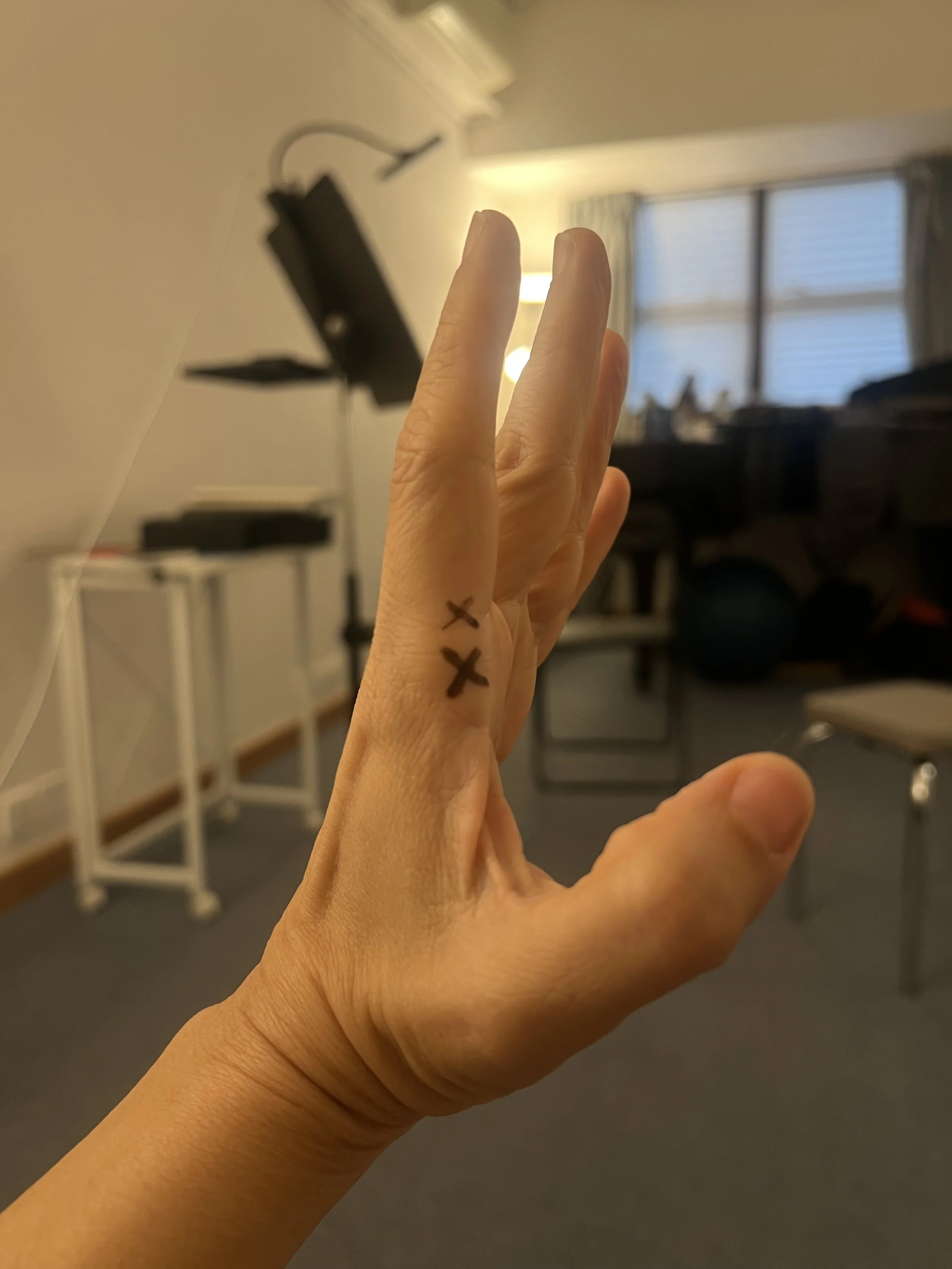
For the advanced or professional player, a deeper exploration of our anatomy reveals a powerful "engine" in the hand. If you touch the Rolland "X,” you will feel that it rests not on the actual joint, but rather on the middle of a bone. Feel where your finger actually bends at the knuckle—that is your MCP joint, frequently referred to in violin literature as the base joint. It sits lower than the Rolland “X.”

Precision matters here. Personally, I find that physically palpating my joint to locate the bend, and marking the “X” on my own hand, clarifies for my mental map of the hand’s anatomy.

The bottom one is our “X”. It marks the lower MCP joint, which serves as the actual engine of the left hand.

This distinction is not a critique of Rolland’s pedagogy. I am a huge admirer of his first-principles approach to the violin, and I believe his visual guide was designed specifically for children, where visibility is far more practical than absolute anatomical precision. His ability to distill complex violin mechanics into natural movement informs and inspires my own view of technique. Ultimately, past a certain point of development, a more precise understanding of mechanics and a refined sense of proprioception will serve to greatly enhance our control of the instrument.

The MCP “X” as Engine and Rudder

Many pedagogues, such as Galamian and Fischer, suggest that left-hand finger movement should originate from this base joint. Beyond that, I propose that the first-finger “X” serves as the engine of the left hand and the rudder for the entire left arm.

It acts as a sensory anchor from which the hand maintains a strong but adaptable frame. There are no fixed rules regarding how much contact it makes with the violin neck, or where it is positioned. The essential factor is that it serves as a consistent proprioceptive reference point. The MCP “X” also drives in different directions depending on its position on the fingerboard, providing vital orientation to naturally steer the arm into the most efficient corresponding positions.

Vibrato

During vibrato, the hand swings back (toward the pegs) from the MCP “X” while the tip joint of the playing finger remains supple on the string. The thumb must remain free to roll slightly, allowing the skin of the thumb to move in tandem with the oscillation. For a wider, more expressive vibrato, pull the “X” slightly away from the neck.

Shifting/Intonation

While the first finger often acts as a guide on the string, utilizing its MCP joint as a stabilizing proprioceptive reference helps coordinate the arm and hand during shifting. This provides a much clearer spatial map, making shifts more precise while ensuring the structural integrity of the hand frame remains intact.

A Stronger Fourth Finger

We have all heard the complaint that “my pinkie is too weak.” However, when the first-finger “X” acts as a reliable proprioceptive locator, the knuckles align naturally. This gives the fourth finger access to the supportive arch of the entire hand, allowing it to utilize the hand's leverage, effectively making it “stronger.”

Finding Optimal Wrist and Arm Alignment

The wrist and arm must adjust dynamically to orient the “X” in the correct direction. By focusing on the trajectory of this base joint, the wrist and arm naturally find their most supportive alignment without the player having to consciously micro-manage every joint.

Fast Passagework and Application

In the video below, I focus on initiating and monitoring the sensation of movement from the MCP joint. This focus reveals all the subtle directional adjustments the left hand naturally makes to facilitate shifts and finger weight transitions that I was previously unaware of. Using a resistance band provides external feedback, helping the hand and arm find the most efficient path of movement.

https://youtu.be/pg_WykAa7W4

And here in the second video, the band work is applied directly to my playing. Even though I lose contact with the “X” slightly while shifting down to the F (third finger on the E string in fifth position), my fingers require far less active effort thanks to the more efficient arm position. Unsurprisingly, the connection this exercise built with my core also made my bow arm feel smoother. This single point of the first finger's MCP joint can indeed have a powerfully galvanizing effect on technique.

https://youtu.be/pg_WykAa7W4

In a future article, I’ll explore how the thumb partners with the MCP “X” to activate the hand’s arch.
[Video] Purposeful Movement: The "Rubber Wrist"

I recently came across the idea of the “rubber wrist” in the left hand—the premise being that the wrist shouldn’t be rigid if we want to maintain a secure hand position. This was demonstrated with some loose, exploratory movement.

We can build on this exercise by looking at the root of why this freedom is so helpful. Understanding these mechanics helps us find the exact boundaries of that movement, allowing us to transition from an intuitive exploration to a precise, intentional practice where we know exactly what physical feedback we are looking for.

Why a Free Wrist Matters

A flexible wrist is essential because it allows the weight of the hand and arm to shift naturally. Instead of squeezing or pressing, we can allow gravity to do the work by using quiet micro-adjustments throughout the entire arm to channel its weight directly down into each finger. In fast passages, this fluid release is what lets us transfer that weight seamlessly from one note to the next.

"Ultimately, speed is not about forcing your fingers to move faster; it is about how quickly you can transfer weight between them."

Try this: The Two-Note Weight Shift

Play only two notes at a time, very slowly.

  • As you transition, focus on feeling the weight shift across your knuckles.

  • Let the second note sit "heavy," acting as a stable, grounded destination.

  • Then, move to the third, letting the weight flow forward to make that note just as heavy.

In the following video, I use a passage from Rimsky-Korsakov’s Scheherazade to show how this works. You’ll see that even while I’m experimenting with what to “relax,” the movement remains quite precise and quiet. I’m simply trying to help gravity do its job.

https://youtu.be/pt64y0b2Hrg

Ultimately, speed is not about forcing your fingers to move faster; it is about how quickly you can transfer weight between them. Learning to indulge in the feeling of this weight shift at a luxuriously slow tempo is what makes fast passages clean.

As you do this, you will discover how little movement is actually required. The nervous system learns by mapping physical feedback, and it thrives on quiet, precise signals. Reducing any extraneous wriggling also minimizes background noise that drowns out the very subtle movement you are trying to learn.

This is why the more we can narrow down exactly what we are looking for whenever we practice, the more fruitful our work becomes. When we aim for true precision stemming from a first-principles understanding of physical mechanics and neuroscience, we transform our practice from an initial exploration into deep, efficient learning.

Bow Grip Vs Sword Grip

There are many different opinions about how to hold the bow. Some say it’s not even a “hold,” and most certainly not a “grip,” but simply “balancing.” To get past the semantics and down to the first principles of what this means, imagine fighting with a sword. What makes it possible for you to swing the sword with control, power, and speed?

If you try gripping your bow like a sword, you’ll immediately feel how you are using what biomechanics calls a power grip. You rely on the bigger structures of your body—your upper arm, your core, and even your legs if you need to swing the sword across your body. In a power grip, the muscles inside the arches of your hand work together to create a more block-like shape to transfer that larger force into the object.

But holding a bow requires what is called a dynamic precision grip. The movements are a lot finer, which means there is way more involvement from the smaller joints and muscles of the fingers. Unlike the more unified grip of a sword, the arches of your hand must remain open and supple. The muscles supporting those arches have to work highly independently of one another—shifting, absorbing shock, and making tiny, highly differentiated micro-adjustments to control the bow.

Yet, even with these fine movements, your fingers still need enough power for any control to happen. This is where semantics and perception can cause confusion in teaching. What I call a "grip" or a "light hold" might feel entirely different to you. In biomechanics, this comes down to perceived exertion. If someone has very strong hands, holding the bow might feel completely effortless. To someone with weaker hands, achieving that exact same hold will feel like a much tighter, more effortful "grip." This is why verbal instructions often leave gaps in understanding.

Once you switch from a sword grip to a proper bow hold, you need to organize your entire arm to use the best of both worlds. This comes down to creating efficient leverage. By carefully positioning your proximal structures—such as organizing your upper arm and adjusting how much the shoulder joint is rotated—you create a mechanical advantage that effortlessly delivers weight and power. At the same time, your distal joints (your forearm, hand, and fingers) provide fine, flexible control. You can think of it as a hybrid concept: a combination of holding a sword and— to use a common analogy— holding a paintbrush. Your upper arm works with the leverage and power of a sword, while your forearm and fingers must manipulate the bow as if handling a paintbrush that’s MUCH heavier than a common one. The upper arm provides the driving force, but your fingers must work actively against that weight to paint very fine details on the canvas.

I will share practical ways to transfer this hybrid approach to the bow hold in the future.

The Clockface

The Clockface

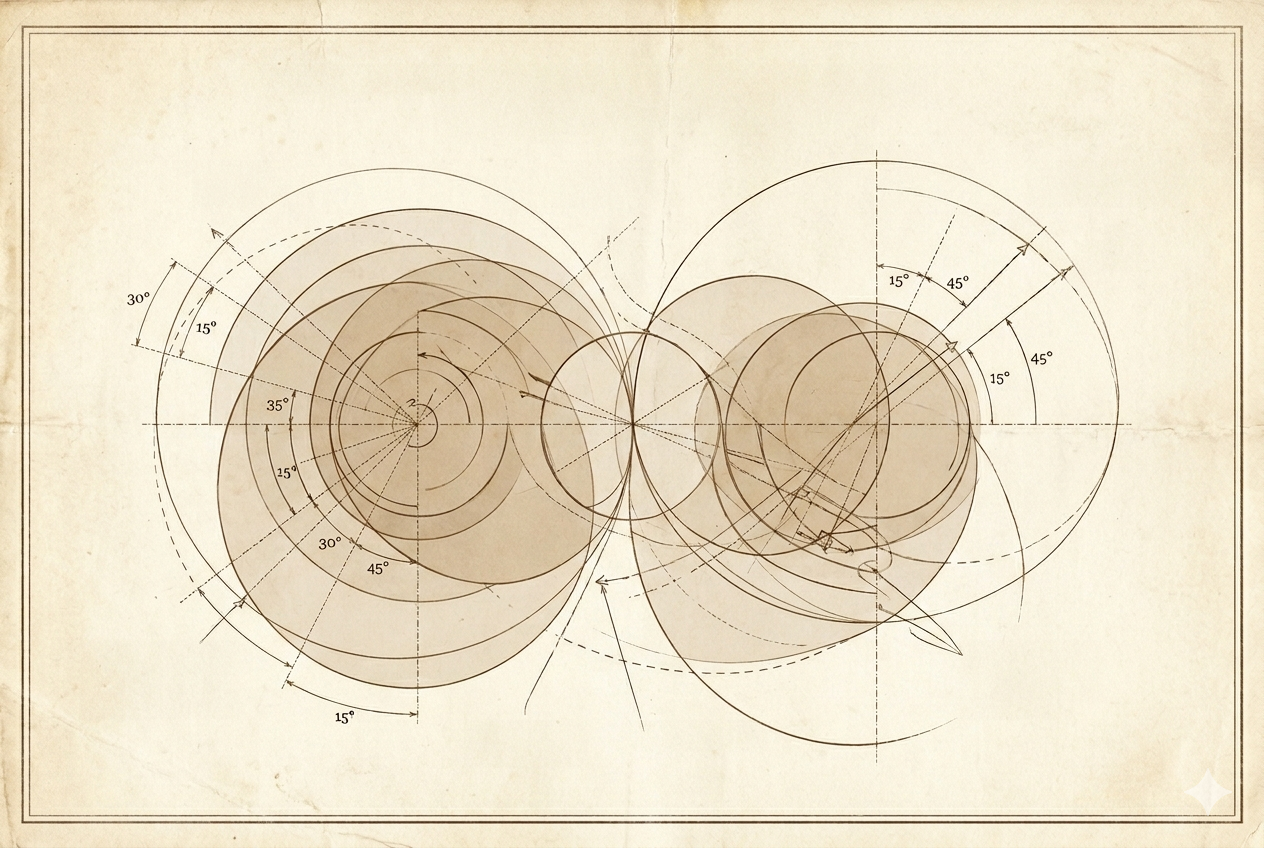
The clockface is a great tool to understand the mechanics of playing and serves as an illuminating aid to teaching. It provides more accurate coordinates for body mapping and more dynamically shows the relationship of how different parts of the body interact with each other. For instance, the “straight” bow isn’t always a down-bow going towards 2 o’clock. Depending on how the body is rotated, the bow typically moves from 2 to 4 o’clock. (Although the description of a “straight bow” can be a valid starting point of instruction, it is inherently a false concept—the bow is never straight in a linear sense.) It’s also a great tool to help each individual understand how they need to adjust according to their own body.

Playing the violin is all about finding the right angles. The clockface can be applied to multiple possibilities beyond bow direction. The clock can represent the holding of the violin, the left arm positioning while shifting, or it can be imagined as being in the chest to allow for ribcage rotation. The clock can also tilt and turn to accommodate any directional change. One can also specify and isolate whether you’re moving the elbow, forearm, or shoulder towards any given clock position. By using these coordinates, one can easily and intuitively change the system of levers in the body without getting into technicalities.

Try to play with a clockface in front of you-I’ve been practicing this way. Experiment with the left side of the body being the hour hand and the right arm being the minute hand. There are always multiple systems of leverage going on when we play, and therefore different sizes, shapes, and placements of clocks. It’s a great way to help one get a deeper understanding of the mechanics of playing.