The "Straight Bow" Trap: Moving Beyond Description toward Expression
What if playing with a "straight" bow isn't a singular action you do, but rather the result of how several different rotations in your body interact?
Think about the clock face again (see: The Clock Face Framework). Imagine the clock lies on the horizontal plane of your body. If your violin scroll is pointing at 10 o’clock versus 11:30, the "straightness" of your bow path changes immediately—before your right arm even moves.
In this light, the angle of the bow is a composite result of at least three factors beyond the arm:
The Instrument's Axis: How you hold the violin and its angle relative to your midline.
Trunk Rotation: The degree of rotation in your torso that brings the violin to the bow.
Digital Extension: The flexibility of the right-hand fingers. The more the fingers extend at the tip, or the more the pinkie is positioned on the inside of the stick, the more the bow naturally moves toward the 2 o’clock angle—the "straight" path.
The danger arises when we isolate the right arm. When a player tries to "force" a straight bow solely through forearm extension (opening the elbow), they often create compensatory extensions.
I have seen students whose entire tone and technique are throttled by trying to "effect" a straight bow through the elbow alone. Even more concerning are adult students who, after a lifetime of diligent adherence to this isolated forearm extension, suffer deep-seated physical damage from these unnatural habits. These reaches aren't just inefficient; they create a ripple effect of tension that compromises every other aspect of playing.
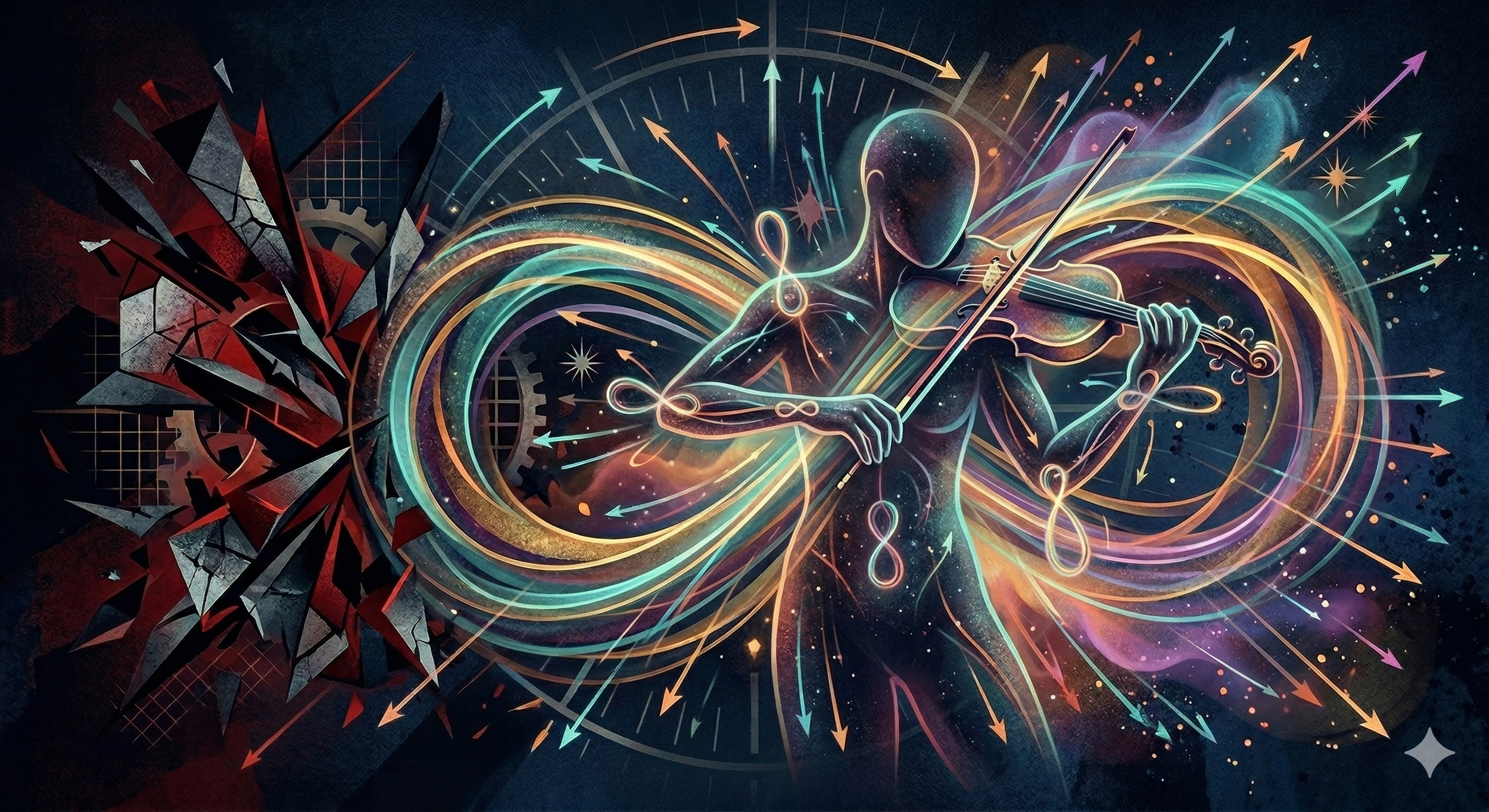
The term "straight bow" is useful as a description of what we see, and it serves well as a visual goal. However, it requires a significant caveat: technically, the bow should not be "perfectly" straight in a geometric sense. It is perfectly natural—and anatomically necessary—for the tip to come slightly toward the body. The path is rarely linear; it involves subtle "figure-8" loops that mirror the natural movement of our joints.
Once the nervous system absorbs these variants of alignment and accepts this natural path, a deeper shift occurs. The physical act of "opening" the body to draw the bow toward the 2 o'clock angle becomes a tool for musical expression, allowing the tone to blossom in a specific way.
In this lexicon, "straightness" is no longer the goal. It becomes a whole-body expression that embodies the different intensities and weights of the music. Whether the bow points more toward 2:30 or 4:30, and how the left side of the body moves in relation to it, cease to be rigid requirements. They become a wider palette that the performer can choose from to both maneuver the instrument and to express.