[Video] The First Finger MCP Joint “X”: Engine of the Hand, Rudder of the Arm
I often emphasize how the body's larger, proximal structures must support the smaller, distal ones. However, focusing on a distal point can also serve as an effective entry point into efficient playing biomechanics, provided we treat the body as an integrated system rather than forcing the fingers and arms into unnatural positions in isolation.
This article explores that alternative pathway: how focusing on a single distal point—the metacarpophalangeal (MCP) joint of the index finger—can act as a sensory anchor that helps the nervous system self-organize for more efficient technique.
Paul Rolland teaches a wonderful setup in which he marks a line at the crease at the base of the first finger, alongside an “X” right beside that line. He instructs students to keep this line visible and the “X” near the violin neck. For children, this serves as an effective, simple visual guide to monitor and maintain a functional hand shape.
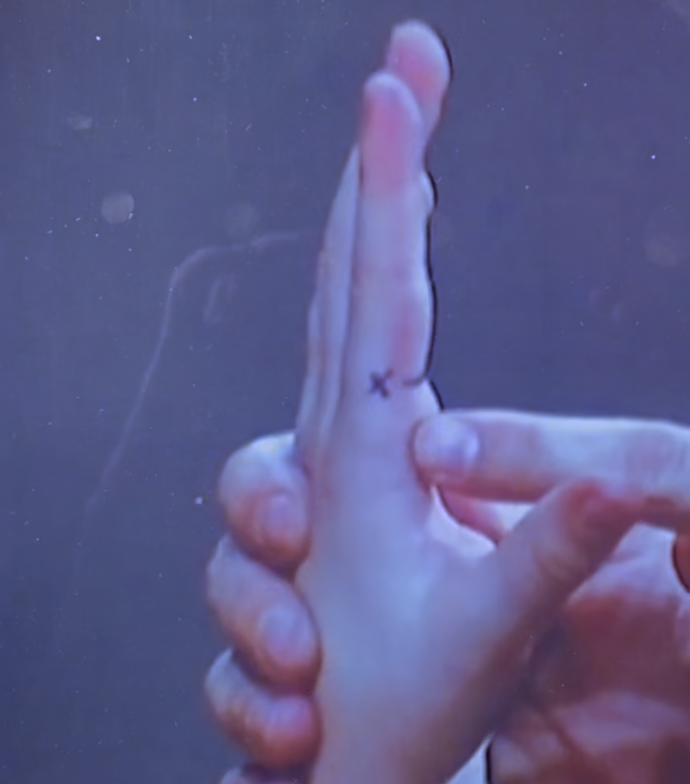
Rolland’s “X”, which marks a point slightly above the MCP joint.
“The first-finger “X”... serves as the engine of the left hand, and the rudder for the entire left arm.”
For the advanced or professional player, a deeper exploration of our anatomy reveals a powerful "engine" in the hand. If you touch the Rolland "X,” you will feel that it rests not on the actual joint, but rather on the middle of a bone. Feel where your finger actually bends at the knuckle—that is your MCP joint, frequently referred to in violin literature as the base joint. It sits lower than the Rolland “X.”
Precision matters here. Personally, I find that physically palpating my joint to locate the bend, and marking the “X” on my own hand, clarifies for my mental map of the hand’s anatomy.
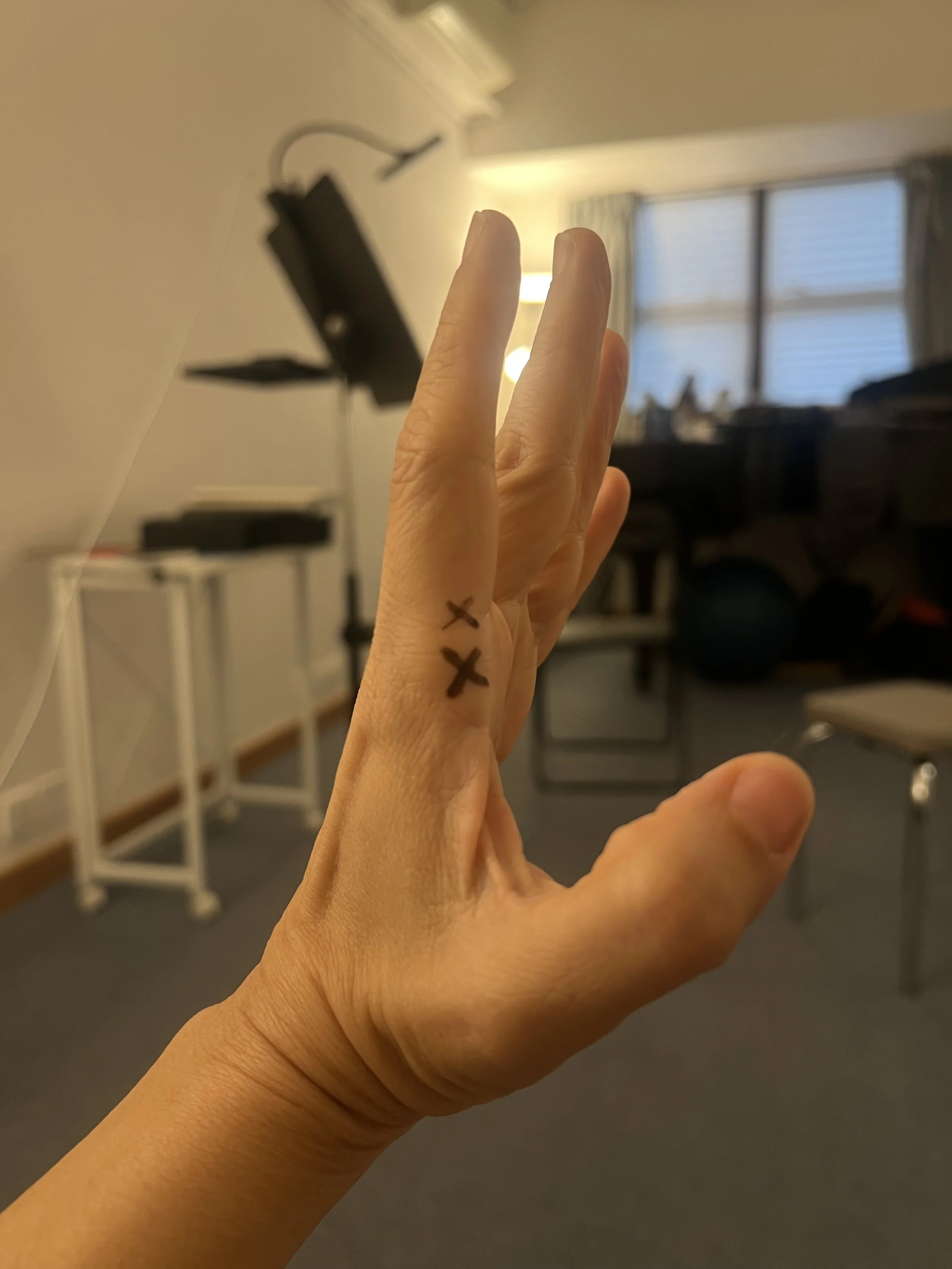
The bottom one is our “X”. It marks the lower MCP joint, which serves as the actual engine of the left hand.
This distinction is not a critique of Rolland’s pedagogy. I am a huge admirer of his first-principles approach to the violin, and I believe his visual guide was designed specifically for children, where visibility is far more practical than absolute anatomical precision. His ability to distill complex violin mechanics into natural movement informs and inspires my own view of technique. Ultimately, past a certain point of development, a more precise understanding of mechanics and a refined sense of proprioception will serve to greatly enhance our control of the instrument.
The MCP “X” as Engine and Rudder
Many pedagogues, such as Galamian and Fischer, suggest that left-hand finger movement should originate from this base joint. Beyond that, I propose that the first-finger “X” serves as the engine of the left hand and the rudder for the entire left arm.
It acts as a sensory anchor from which the hand maintains a strong but adaptable frame. There are no fixed rules regarding how much contact it makes with the violin neck, or where it is positioned. The essential factor is that it serves as a consistent proprioceptive reference point. The MCP “X” also drives in different directions depending on its position on the fingerboard, providing vital orientation to naturally steer the arm into the most efficient corresponding positions.
Vibrato
During vibrato, the hand swings back (toward the pegs) from the MCP “X” while the tip joint of the playing finger remains supple on the string. The thumb must remain free to roll slightly, allowing the skin of the thumb to move in tandem with the oscillation. For a wider, more expressive vibrato, pull the “X” slightly away from the neck.
Shifting/Intonation
While the first finger often acts as a guide on the string, utilizing its MCP joint as a stabilizing proprioceptive reference helps coordinate the arm and hand during shifting. This provides a much clearer spatial map, making shifts more precise while ensuring the structural integrity of the hand frame remains intact.
A Stronger Fourth Finger
We have all heard the complaint that “my pinkie is too weak.” However, when the first-finger “X” acts as a reliable proprioceptive locator, the knuckles align naturally. This gives the fourth finger access to the supportive arch of the entire hand, allowing it to utilize the hand's leverage, effectively making it “stronger.”
Finding Optimal Wrist and Arm Alignment
The wrist and arm must adjust dynamically to orient the “X” in the correct direction. By focusing on the trajectory of this base joint, the wrist and arm naturally find their most supportive alignment without the player having to consciously micro-manage every joint.
Fast Passagework and Application
In the video below, I focus on initiating and monitoring the sensation of movement from the MCP joint. This focus reveals all the subtle directional adjustments the left hand naturally makes to facilitate shifts and finger weight transitions that I was previously unaware of. Using a resistance band provides external feedback, helping the hand and arm find the most efficient path of movement.
https://youtu.be/pg_WykAa7W4
And here in the second video, the band work is applied directly to my playing. Even though I lose contact with the “X” slightly while shifting down to the F (third finger on the E string in fifth position), my fingers require far less active effort thanks to the more efficient arm position. Unsurprisingly, the connection this exercise built with my core also made my bow arm feel smoother. This single point of the first finger's MCP joint can indeed have a powerfully galvanizing effect on technique.
https://youtu.be/pg_WykAa7W4
In a future article, I’ll explore how the thumb partners with the MCP “X” to activate the hand’s arch.